Trench Crusade is a skirmish game set in an alternate history where the Crusades cracked something open that could not be closed. The war has been running for centuries. By the time the game takes place, the front looks like WWI filtered through genuine theological horror — gas masks, trench coats, barbed wire, and things that should not exist advancing across cratered mud.
The setting makes a specific demand of the table. A flat board with some scatter terrain fails it. The trench network has to be real enough that the game’s tactical structure — holding ground, advancing under fire, breaking through — actually functions. That means physical walls that block sight lines, floors that define movement corridors, and modular construction that lets you change the layout between scenarios without rebuilding from scratch.
The Trench Sections
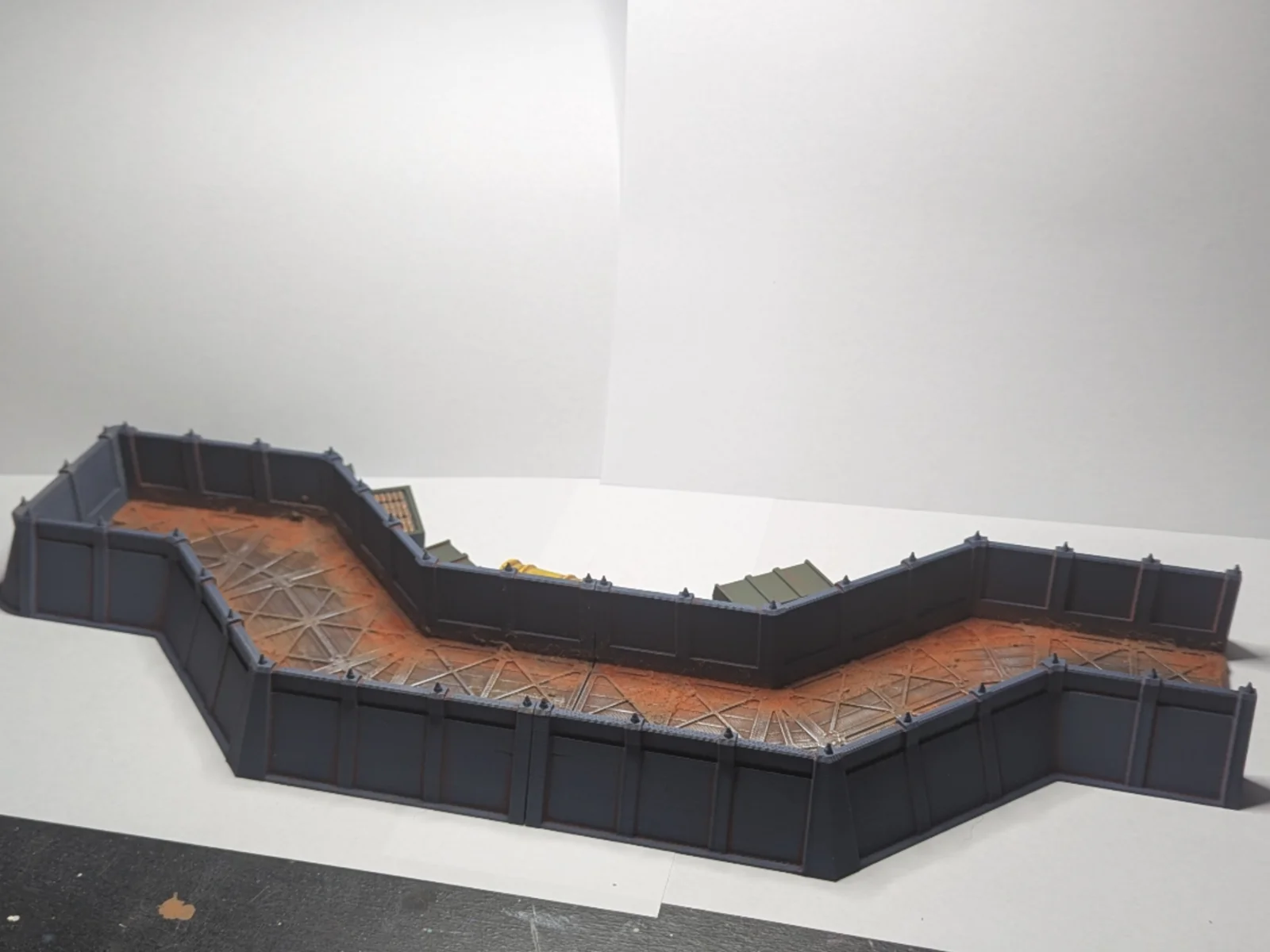
The sections in the photo above are FDM-printed in modular segments. Each piece connects end to end without gaps or height steps. The corrugated iron walls are a single print — no separate planks to lose. Rivets and panel seams survive primer because they are sized to hold at 0.2 mm layer height. The floor texture comes through after a wash and dry brush. You end up with mud and rust without any manual work to get there.
The zigzag layout in the photo is two sections — a straight run and a dog-leg. Four sections cover a standard Trench Crusade deployment zone. Eight give you a full table with a no man’s land gap in the center. They store flat, stack cleanly, and survive transport in a tackle box.
Scatter for No Man’s Land
The space between the trenches matters as much as the trenches themselves. Czech hedgehogs, sandbag stacks, shell craters, and wire tangles are not decoration — they are the difference between a suicidal charge and a covered advance. Printed hedgehogs take about forty minutes each on FDM and dry-brush to rusted steel in under ten minutes. A set of six fills a no man’s land gap and gives both players meaningful route decisions.
The Warbands
Trench Crusade runs at 28–32 mm scale. Resin handles the character models well — the detail in a gas mask, a corrupted officer’s uniform, or an angelic war form needs that surface crispness to read on the table. FDM works for bulk line troops where durability matters more than edge sharpness.
If you are building a Trench Crusade table, send the warband composition and table size. I will quote trench sections, scatter, and models as a package or separately — whatever fits the build.